
Blogs
Turning Standards Into Strength
We don’t just help you achieve compliance—we help you leverage it as a tool for growth, resilience, and competitive advantage.
ISO 9001 in 2026: What Organizations Should Revisit in Their Quality Management Systems
Is your ISO 9001 system still working—or is it simply still certified? That question is becoming increasingly important for organizations in 2026. Many businesses have had an ISO 9001-certified Quality Management System (QMS) for years. Procedures are documented....
Business Continuity Management: Preparing Your Business for Disruption
What if your biggest business continuity risk isn't the disruption itself—but the first 60 minutes after it happens? A system goes down. A critical supplier stops responding. A cyber incident affects your operations. Your facility becomes inaccessible. A key person is...
Total Productivity Management for Automotive Manufacturing: The Hidden Levers of Factory Performance
By Prasad Kale Industrial Operations & Energy Management Expert | 37 Years of Experience Introduction: What If Your Factory Is Busy—But Not Truly Productive? Walk into an automotive manufacturing plant during a busy shift and you may see everything that appears to...
Operational Excellence in B2B Pharma: How Quality, Lean Six Sigma and ESG Drive Sustainable Growth
The pharmaceutical industry operates in an environment where quality, compliance, cost efficiency and customer trust are critical to business success. For B2B pharmaceutical companies, improving internal processes is not simply about reducing costs—it is about...

The Mandar Approach to Quality: Why Defects Cost More Than They Look
A defect rarely costs what the defect report says it costs. A rejected component may appear as a ₹5,000 quality issue. A failed transaction may appear as a 20-minute rework item. A customer complaint may be logged as a service incident. A software vulnerability may be...

The Cost of Delay: What Is Your Organization Really Losing by Waiting?
The Mandar Approach to Turning Delay into a Business Performance Question Organizations are generally good at calculating the cost of action. They prepare business cases. They estimate investment. They calculate implementation costs. They debate resources, budgets and...
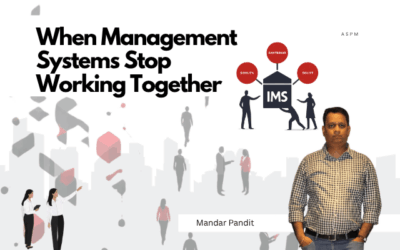
When Management Systems Stop Working Together
THOUGHT LEADERSHIP · MANDAR PANDIT When Management Systems Stop Working Together Why the future of organizational performance is not another certification—but integration By Mandar Pandit | Founder & Director, ASPM Consulting Walk into a modern organization and...
Business Transformation: Why Strategy Alone Does Not Deliver Results
1. The Business Challenge In boardrooms across the globe, significant resources, capital, and intellectual bandwidth are invested in formulating growth strategies. Executive leadership teams conduct market assessments, refine value propositions, and set ambitious...
How Manufacturing Plants Can Reduce Energy Costs Without Affecting Production
Author: Prasad Kale — G.M.Energy Management | Industrial Operations & Energy Management Expert | 37 Years of ExperienceFor many manufacturing plants, energy is treated as an unavoidable operating expense. Electricity, fuel, steam, compressed air, chilled water,...

How Pharmaceuticals & Life Sciences Companies Can Prepare for ESG Requirements
For pharmaceutical and life sciences companies, ESG is increasingly becoming a business-management issue rather than a standalone sustainability initiative. The reason is straightforward: pharmaceutical companies operate across complex supply chains, highly regulated...

Food Supply Chain Risk: How Businesses Can Ensure Continuity
Introduction Food businesses operate within a supply chain where agricultural commodities, ingredients, packaging materials, processing facilities, logistics providers, distributors and retailers are closely connected. A disruption at one point can quickly affect the...
Automotive Supply Chain Risk: How Manufacturers Can Build Resilience
Introduction An automotive vehicle may contain thousands of individual components, sourced through a complex network of manufacturers, suppliers, logistics providers and service partners. A disruption at one point in that network can affect the entire production...