THOUGHT LEADERSHIP · MANDAR PANDIT
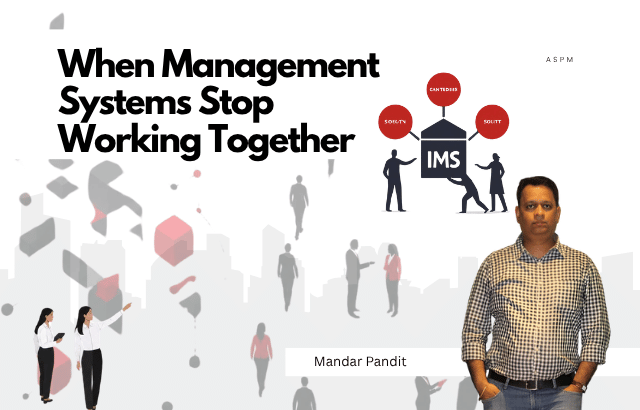
When Management Systems Stop Working Together
Why the future of organizational performance is not another certification—but integration
an Environmental Management System, an Occupational Health & Safety System,
an Information Security Management System, a Business Continuity System and,
increasingly, ESG and sustainability frameworks.Each one may be well designed.Each may have its own objectives, policies, procedures, audits, dashboards and owners.
And yet, something important can still be missing.
Connection.
The organization may have many management systems—but not necessarily
one management system for the organization.
That distinction is becoming increasingly important.
The Hidden Cost of Fragmented Management Systems
For years, organizations have responded to new requirements by building new systems.
A customer asks for stronger quality controls.
A new regulation creates privacy requirements.
Investors ask for ESG information.
Cyber risks increase.
Customers demand sustainability data.
Business disruption highlights the need for continuity planning.
The natural response is to create another framework.
Over time, the organization accumulates systems.
- Quality has its meetings.
- Environment has its objectives.
- Safety has its committees.
- Cybersecurity has its controls.
- Business continuity has its plans.
- ESG has its reporting cycle.
The result can be technically compliant—but operationally fragmented.
People start asking:
- Which system owns this?
- Which objective takes priority?
- Which data should we trust?
- Why are we measuring the same process in five different ways?
- Why does every audit ask for similar evidence in a different format?
These are not simply documentation problems.
They are architecture problems.
A Management System Should Reflect the Business
A business does not naturally operate in ISO chapters.
Customers do not place orders according to Clause 8.
Employees do not experience risk according to organizational boundaries.
Cyber incidents do not wait for an annual management review.
Climate-related disruption does not fit neatly into a single department.
Real business processes cross functions.
That means management systems should cross them too.
Instead of asking:
“How do we implement another standard?”
I believe organizations should increasingly ask:
“How does this requirement strengthen the way our business already works?”
That is a fundamentally different question.
From Compliance Architecture to Business Architecture
Consider a manufacturing organization.
Its quality team is monitoring defects.
Its sustainability team is monitoring emissions.
Its energy team is monitoring consumption.
Its safety team is monitoring incidents.
Its cybersecurity team is monitoring threats.
Its business continuity team is assessing disruption.
On paper, these appear to be different subjects.
At the operational level, they are connected.
A change in equipment can influence:
A cybersecurity incident can influence:
A supplier issue can influence:
The organization is already interconnected.
The management architecture should reflect that reality.
Integration Does Not Mean Making Everything Identical
This is an important distinction.
Integration is not about eliminating specialized expertise.
A cybersecurity professional still needs cybersecurity expertise.
An environmental professional still needs environmental expertise.
A quality professional still needs quality expertise.
The objective is not to erase those disciplines.
It is to connect them around the organization’s common objectives.
Think of it as an orchestra.
The instruments remain different.
But they perform from the same composition.
The Five Layers of an Integrated Business System
I see an effective integrated system as having five connected layers.
01
Strategy
What is the organization trying to achieve?
Growth, customer value, resilience, sustainability,
operational excellence and profitability should not
exist as disconnected ambitions.
02
Risk
What could prevent those objectives from being achieved?
Risk should connect quality, operational, environmental,
cybersecurity, safety, supply-chain and business-continuity considerations.
03
Operations
Where does the work actually happen?
Requirements must ultimately become part of processes,
responsibilities, technology and decision-making.
04
Measurement
How do we know whether the system is working?
Organizations should move beyond collecting indicators
simply because a standard asks for them.
05
Improvement
What changes as a result?
A management system that produces reports but does not
change decisions is producing information—not improvement.
The Real Opportunity for ESG
This is particularly relevant to ESG.
There is a temptation to treat ESG as another reporting exercise.
But ESG becomes much more valuable when it connects to the
organization’s existing operating architecture.
Environmental performance
Social performance
Governance
The result is a shift from
ESG reporting to ESG-informed management.
That is a much more meaningful role for sustainability inside the organization.
What Happens When the Systems Are Integrated?
The objective isn’t simply fewer documents.
The real benefits can be much deeper:
- Fewer duplicated processes
- Clearer ownership
- Better management visibility
- More meaningful performance indicators
- Stronger risk awareness
- Better use of organizational data
- Reduced audit fatigue
- More consistent decision-making
- Greater organizational resilience
Most importantly, people stop seeing management systems as an
external compliance burden.
They start seeing them as part of
how the business is run.
The Next Generation of Management Systems
I believe organizations are entering a different phase.
The question is no longer:
“How many standards do we have?”
The better question is:
“How effectively do our systems work together?”
The competitive advantage will increasingly come from organizations
that can connect seemingly different priorities:
- Quality with productivity.
- Sustainability with efficiency.
- Cybersecurity with resilience.
- Compliance with governance.
- Risk with strategy.
- Data with decision-making.
- Management systems with business performance.
This is where the role of the management-system professional needs to evolve.
Not simply from auditor to implementer.
But from standard specialist to business systems architect.
From Certificates to Capability
A certificate can demonstrate that a system meets defined requirements
at a particular point in time.
But a resilient organization needs something more.
It needs capability.
- The capability to identify change.
- The capability to understand risk.
- The capability to respond.
- The capability to learn.
- The capability to improve.
- The capability to connect decisions across the organization.
That is why I believe the future of management systems is not about
building more isolated frameworks.
It is about building
one organizational architecture capable of supporting many objectives.
The Ultimate Test
The ultimate test of a management system should not be:
“Can we pass the audit?”
It should be:
“Does this system help us make better decisions
and build a better organization?”
If the answer is yes, compliance becomes a consequence of good
management—not the purpose of it.
And that is the shift organizations should be preparing for.
About the Author
Mandar Pandit is Founder & Director of
ASPM Consulting, with professional focus spanning
Lean Management, Quality, Sustainability, ESG, EcoVadis,
Information Security, Privacy, Business Continuity, Cybersecurity
and integrated management systems.
His work focuses on connecting management-system disciplines with
operational performance, organizational resilience and sustainable
business growth.