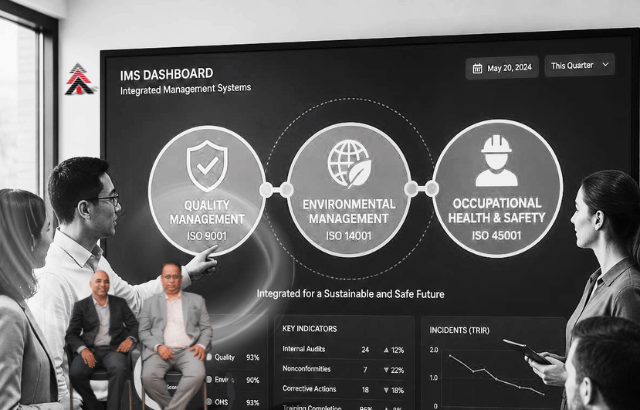
Organisations often introduce multiple management systems as they grow.
ISO 9001 for quality. ISO 14001 for environmental management. ISO 45001 for occupational health and safety. ISO 27001 for information security. And, depending on the organisation, other standards may also become relevant.
Each standard can address an important business need.
But there is a risk.
If every standard creates its own procedures, forms, audits, meetings, registers and reporting requirements, the management system can quickly become complicated.
Employees may start asking:
“Why do we have so many systems?”
The answer is not to eliminate the standards.
It is to integrate them into the way the organisation already operates.
An Integrated Management System (IMS) can bring multiple management-system requirements together through common processes, responsibilities, controls and performance measures.
What Is an Integrated Management System?
An Integrated Management System combines two or more management systems into a coordinated framework.
For example, an organisation may integrate:
- ISO 9001 – Quality Management
- ISO 14001 – Environmental Management
- ISO 45001 – Occupational Health and Safety
- ISO 27001 – Information Security
The objective is not to create one large document containing every requirement.
The objective is to establish one practical management framework that addresses different requirements without unnecessary duplication.
Many ISO management-system standards share a common structure and terminology, which supports organisations that want to operate a single integrated system.
Why Integrated Systems Can Become Bureaucratic
The problem usually starts when organisations interpret integration as adding more documentation.
A typical approach might look like this:
- One procedure for quality
- One procedure for environment
- One procedure for safety
- Separate risk registers
- Separate audit programmes
- Separate corrective-action systems
- Separate management meetings
- Separate performance reports
Each element may appear reasonable individually.
Collectively, however, they can create a system that employees find difficult to understand and maintain.
The goal of integration should therefore be simplification, not consolidation for its own sake.
Start With the Business, Not the Standards
One of the most important principles for building an effective IMS is to start with how the organisation actually operates.
Before mapping clauses, ask:
- What are our core business processes?
- What are we trying to achieve?
- What risks could affect those objectives?
- What legal and customer requirements apply?
- What controls already exist?
- What information does leadership need to make decisions?
Once the business processes are understood, the requirements of different standards can be mapped into those processes.
This is much more effective than building separate systems and attempting to connect them later.
Build Around Common Processes
Most organisations already have processes for managing their business.
These may include:
- Strategic planning
- Sales and customer management
- Procurement
- Operations
- Maintenance
- Human resources
- Information technology
- Risk management
- Performance monitoring
The management system should strengthen these processes rather than create parallel activities.
For example, procurement may need to consider quality, environmental and safety requirements.
Instead of creating three separate procurement systems, the organisation can establish one procurement process with the relevant criteria built into it.
Use One Risk Management Approach Where Practical
Risk is a common theme across modern management systems, although each standard has its own discipline-specific requirements.
An organisation should therefore look for opportunities to coordinate its risk management activities.
For example, a supplier may create:
- Quality risks
- Environmental risks
- Health and safety risks
- Information-security risks
- Business continuity risks
Instead of maintaining disconnected assessments, organisations can develop a coordinated approach that identifies the relevant risk categories and applies the appropriate controls.
The important point is to integrate where requirements genuinely overlap while preserving the specific requirements of each discipline.
Combine Documentation Where It Makes Sense
Not every requirement needs a separate procedure.
Consider combining common processes such as:
- Documented information control
- Internal audits
- Corrective action
- Management review
- Training and competence
- Performance monitoring
- Risk management
For example, a single internal audit programme can evaluate quality, environmental, safety and information-security requirements where appropriate.
Similarly, one corrective-action process can capture different types of nonconformities and improvement opportunities.
Do Not Force Everything Into One Process
Integration does not mean that every requirement must be treated identically.
Some requirements are discipline-specific.
For example, environmental aspects under ISO 14001 and occupational health and safety hazards under ISO 45001 require different forms of evaluation and control.
The better approach is:
Integrate the common elements. Maintain specialist controls where they are genuinely necessary.
This prevents integration from becoming superficial.
Make Internal Audits More Efficient
Internal audits are often an area where organisations create unnecessary duplication.
Instead of scheduling completely separate audits for every standard, consider developing a process-based audit programme.
For example, an operations audit could examine relevant:
- Quality controls
- Environmental controls
- OH&S controls
- Operational risks
- Performance indicators
This provides a more realistic view of how the business operates.
It also helps auditors evaluate whether the management system is actually supporting business performance rather than simply checking whether documents exist.
Bring Management Review Into the Business
Management review should not become a separate meeting created only to satisfy ISO requirements.
Leadership already reviews business performance.
The opportunity is to integrate management-system information into existing management discussions.
For example, leadership can review:
- Business objectives
- Customer performance
- Operational performance
- Quality issues
- Environmental performance
- Safety performance
- Information-security risks
- Audit findings
- Corrective actions
- Emerging risks
The objective is to help leadership make decisions.
If a management review does not influence decisions, resources or priorities, it is worth asking whether the review is creating value.
Use One Performance Framework
Another common source of bureaucracy is having separate KPI dashboards for every standard.
Instead, develop a balanced performance framework.
For example, leadership may monitor:
- Customer satisfaction
- Process performance
- Defect and rework levels
- Environmental performance
- Safety performance
- Security incidents
- Supplier performance
- Corrective-action effectiveness
- Employee capability
The specific measures will depend on the organisation.
The principle is simple:
Measure what helps the organisation make better decisions.
Make Employees’ Jobs Easier, Not Harder
An IMS will fail if employees see it as additional administration.
Employees should understand how the system helps them perform their work.
For example:
- A checklist should prevent missed steps.
- A risk assessment should help people identify hazards and controls.
- A procedure should clarify how important work is performed.
- A KPI should help teams understand performance.
- A corrective action should help prevent recurring problems.
If a document or activity does not support one of these purposes, its value should be questioned.
Five Principles for a Low-Bureaucracy IMS
1. One Business Process, Multiple Requirements
Where practical, integrate ISO requirements into existing business processes rather than creating parallel systems.
2. One Source of Truth
Avoid maintaining multiple versions of the same information across different systems and registers.
3. One Coordinated Audit Approach
Use risk and process-based auditing to assess multiple requirements efficiently.
4. One Management View
Give leadership a consolidated view of performance, risks, compliance and improvement.
5. Continual Simplification
Review the management system periodically and remove documents, meetings, controls or activities that no longer add value.
Technology Can Help — But It Is Not the Solution
Digital platforms can make an IMS easier to manage.
They can support:
- Document control
- Risk registers
- Audit management
- Corrective actions
- Training records
- Performance dashboards
- Notifications and workflows
But technology cannot fix a poorly designed management system.
Digitising unnecessary processes simply creates faster bureaucracy.
The first step should always be to simplify the process. Technology should then support it.
How to Know Whether Your IMS Is Too Bureaucratic
Ask employees and process owners a few simple questions:
- Do you understand why these requirements exist?
- Are there duplicate forms or records?
- Do different departments ask for the same information?
- Are meetings producing useful decisions?
- Do audits identify meaningful improvements?
- Can you easily find the information you need?
- Does the system help you perform your work?
If employees consistently describe the management system as complicated, administrative or disconnected from daily operations, it may be time to redesign it.
The Goal Is Integration, Not More Administration
A well-designed Integrated Management System should make the organisation easier to manage, not harder.
It should connect:
Strategy → Processes → Risks → Controls → Performance → Improvement
The standards provide requirements and frameworks.
The organisation decides how those requirements are translated into practical processes.
That distinction is critical.
An IMS should not exist to produce more paperwork. It should help leadership understand performance, help employees manage risks and help the organisation improve.
How ASPM Consulting Can Help
ASPM Consulting helps organisations design, integrate and improve management systems across quality, environmental management, occupational health and safety, risk and organisational performance.
Our focus is on creating management systems that are practical, integrated and aligned with business objectives.
If your organisation is operating multiple ISO standards and employees are struggling with duplicated procedures, audits, registers or reporting, an IMS assessment can help identify where the system can be simplified.
The objective should not be to build a bigger management system.
It should be to build a better one.