Building Smarter, Faster, and More Sustainable Organizations Through Lean Thinking
ASPM Consulting helps organizations transform operations into high-performance systems by eliminating waste, improving flow, and building a culture of measurable continual improvement through Lean Excellence.
In today’s competitive business environment, organizations face constant pressure to improve productivity, reduce operational costs, enhance quality, manage risks, and deliver greater value to customers. While many businesses focus on short-term problem-solving, sustainable growth requires a structured approach that improves processes, empowers people, and creates systems capable of continual improvement.
This is where Lean Excellence becomes a strategic advantage.
Through a combination of Lean Six Sigma methodologies, ISO frameworks, and risk-based advisory practices, ASPM Consulting helps organizations identify inefficiencies, optimize workflows, and establish a culture of operational excellence.
With the leadership of Mandar Pandit, Founder & Director | Lean Six Sigma, ISO & Risk Advisory Expert, ASPM Consulting brings practical industry knowledge and a results-driven approach to help organizations move from reactive problem-solving to proactive performance improvement.
As a Domain Expert, Mandar Pandit focuses on connecting operational excellence with business sustainability by helping organizations reduce waste, improve resource utilization, strengthen governance, and build future-ready systems.
What Is Lean Excellence?
Lean Excellence is a management approach focused on maximizing customer value while minimizing activities that do not contribute to that value.
The fundamental objective is:
Deliver more value to customers by using fewer resources, reducing waste, and continually improving processes.
Lean does not mean simply reducing costs. It means creating smarter processes where every activity has a clear purpose and contributes to organizational goals.
Lean Excellence is built around five fundamental principles:
1. Identify Customer Value
Every improvement journey begins by understanding what customers truly value.
Customers typically expect:
- High-quality products or services
- Faster delivery
- Consistent performance
- Competitive pricing
- Reliable support
Organizations often spend significant time and resources on activities that customers do not directly value. Lean thinking helps identify these gaps and redirect efforts toward value creation.
Practical Example
A company may discover that customers value faster delivery, but its internal process includes multiple approval stages that delay shipment.
By simplifying unnecessary approvals, the organization improves delivery speed without compromising quality.
2. Identify and Eliminate Waste
Lean identifies eight common forms of waste that impact operational performance:
- Overproduction
- Waiting time
- Excess inventory
- Unnecessary transportation
- Over-processing
- Excess movement
- Defects and rework
- Underutilized employee skills
Real-World Scenario
A manufacturing company was experiencing production delays despite having sufficient manpower and equipment.
A Lean assessment revealed that operators were spending excessive time searching for tools and materials.
By implementing workplace organization practices through 5S methodology, the company reduced unnecessary movement and improved productivity.
The improvement was not achieved by adding more resources but by optimizing existing resources.
3. Create Smooth Process Flow
Efficient organizations ensure that work moves continually without unnecessary interruptions.
A typical inefficient process may look like:
Order Received → Waiting → Approval → Waiting → Production → Waiting → Delivery
A Lean-focused process redesign creates:
Order Received → Quick Approval → Production → Delivery
By removing unnecessary waiting periods, organizations can improve turnaround time and customer satisfaction.
Simple Calculation
Assume:
- Current order processing time = 10 days
- Actual value-added work = 3 days
Non-value-added time:
10 – 3 = 7 days
If Lean improvements reduce waiting time by 50%:
7 × 50% = 3.5 days saved
New process time:
10 – 3.5 = 6.5 days
A simple process improvement can create measurable business impact.
4. Establish Pull-Based Operations
Traditional systems often produce based on forecasts, which can lead to excess inventory and unnecessary costs.
Lean organizations use demand-based systems where production and resources are aligned with actual requirements.
Example
A company maintaining inventory worth ₹50 lakh may discover that only ₹30 lakh inventory is required for smooth operations.
By optimizing inventory levels:
Excess inventory reduced:
₹50 lakh – ₹30 lakh = ₹20 lakh
This improves cash flow, reduces storage costs, and minimizes waste.
5. Build a Culture of Continual Improvement
Lean Excellence is not a one-time project. It is a continual journey where employees at every level contribute improvement ideas.
Small improvements, when repeated consistently, create significant organizational transformation.
A culture of continual improvement encourages:
- Employee involvement
- Data-based decision-making
- Problem-solving mindset
- Innovation at every level
The Domain Expert Perspective: Connecting Lean with Sustainable Business Growth
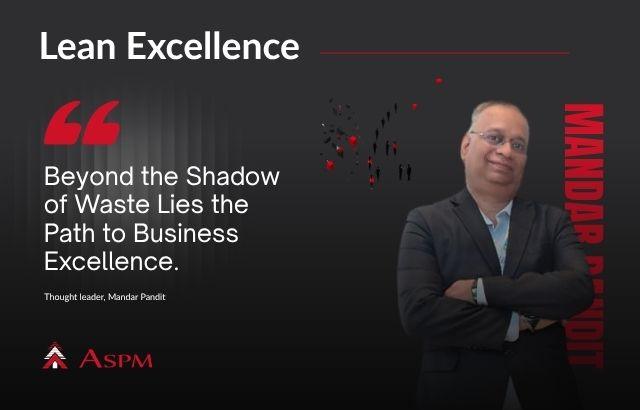
A modern operational excellence leader must look beyond efficiency alone. Businesses today require systems that are productive, resilient, compliant, and sustainable.
As a Domain Expert, Mandar Pandit believes Lean Excellence should create value across multiple dimensions:
- Operational efficiency
- Business resilience
- Risk reduction
- Customer satisfaction
- Sustainable growth
Lean practices naturally support sustainability because reducing waste also reduces unnecessary resource consumption.
For example:
A manufacturing company reducing material rejection from 5% to 2% achieves more than quality improvement.
It also achieves:
- Lower raw material wastage
- Reduced production losses
- Improved profitability
- Better environmental performance
This demonstrates how operational excellence and responsible business practices can work together.
Case-Based Insight: Transforming Manufacturing Performance
A manufacturing organization approached ASPM Consulting with challenges including:
- Increasing production delays
- High defect rates
- Machine downtime
- Poor workplace organization
- Rising operational costs
Initial Assessment Findings
The process analysis identified:
- 30% of delays were caused by waiting time
- 20% of productivity losses were related to workplace inefficiencies
- Repeated defects were increasing rework costs
Improvement Approach
ASPM Consulting implemented a structured Lean improvement framework using:
- 5S Workplace Management
- Root Cause Analysis
- Kaizen Improvement Activities
- Standard Work Procedures
- Visual Management Systems
- Performance Monitoring
Measurable Improvement Example
Before improvement:
Daily production output = 1,000 units
Defect rate = 5%
Defective units:
1,000 × 5% = 50 units per day
After improvement:
Defect rate reduced to 2%
Defective units:
1,000 × 2% = 20 units per day
Improvement achieved:
50 – 20 = 30 fewer defective units daily
Annual impact:
30 × 300 working days = 9,000 fewer defective units annually
This example highlights how data-driven Lean improvements can create significant operational benefits.
Lean Improvement Frameworks Used by ASPM Consulting
PDCA Cycle: Creating Continual Improvement
The Plan-Do-Check-Act (PDCA) framework provides a structured approach for solving problems.
Plan
Identify the problem, analyze current performance, and define improvement objectives.
Do
Implement solutions and test improvements.
Check
Measure results and compare performance against objectives.
Act
Standardize successful improvements and continue optimization.
DMAIC Framework: Data-Driven Problem Solving
Lean Six Sigma organizations use the DMAIC methodology:
Define
Clearly define the business problem.
Measure
Collect relevant performance data.
Analyze
Identify root causes behind performance gaps.
Improve
Implement effective solutions.
Control
Maintain improvements through monitoring systems.
How ASPM Consulting Supports Lean Transformation
ASPM Consulting enables organizations to build high-performance systems through a structured improvement approach.
Operational Assessment
Understanding current processes, identifying bottlenecks, and evaluating improvement opportunities.
Process Optimization
Redesigning workflows to reduce waste, improve efficiency, and increase operational performance.
Capability Development
Training teams with practical Lean Six Sigma tools and problem-solving techniques.
Sustainable Improvement Systems
Developing management systems that ensure improvements continue beyond initial implementation.
Why Lean Excellence Matters for Future-Ready Organizations
Organizations that embrace Lean Excellence gain the ability to:
- Improve operational efficiency
- Reduce unnecessary costs
- Enhance customer experience
- Increase employee engagement
- Strengthen risk management
- Improve sustainability performance
- Build resilient business models
In a rapidly changing business environment, organizations that continually improve are better positioned to compete, innovate, and grow.
Frequently Asked Questions (FAQs)
What is Lean Excellence in simple terms?
Lean Excellence is a systematic approach to improving business performance by eliminating waste, improving processes, and delivering greater customer value.
Is Lean only applicable to manufacturing companies?
No. Lean principles can be applied across industries including healthcare, banking, IT services, logistics, construction, and professional services.
For example, an IT company can use Lean methods to reduce unnecessary approval cycles and improve project delivery timelines.
How does Lean improve sustainability?
Lean reduces waste, improves resource utilization, minimizes unnecessary activities, and helps organizations operate more responsibly.
How quickly can organizations see Lean improvement results?
Some improvements can be achieved within weeks, especially in areas such as workplace organization, process flow, and waste reduction. Long-term cultural transformation requires continual commitment.
What role does leadership play in Lean transformation?
Leadership commitment is essential. Leaders must encourage improvement initiatives, support employee participation, and create an environment where continual improvement becomes part of daily operations.
How does ASPM Consulting approach Lean implementation?
ASPM Consulting combines Lean Six Sigma expertise, ISO knowledge, risk advisory practices, and industry experience to deliver practical improvement solutions aligned with business objectives.
The Future of Operational Excellence
Lean Excellence is no longer limited to cost reduction. It is about creating intelligent, adaptable, and sustainable organizations capable of delivering long-term value.
Through the expertise of Mandar Pandit, Founder & Director | Lean Six Sigma, ISO & Risk Advisory Expert, ASPM Consulting continues to support organizations in transforming traditional operations into high-performance systems.
By combining Lean methodologies with a Domain Expert approach, businesses can achieve operational excellence, strengthen resilience, and create a foundation for sustainable growth.
ASPM Consulting — Transforming Operations. Building Excellence. Creating Sustainable Business Value.